
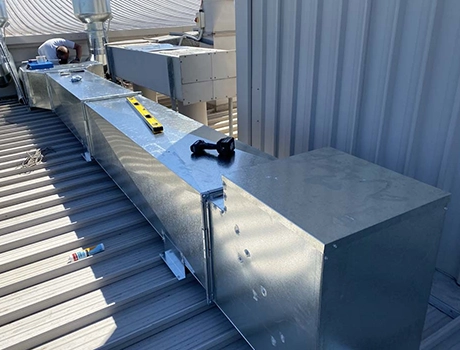
See how custom duct transitions solve alignment and space constraints in HVAC retrofits. Discuss drawings, materials and site needs with Metcon Steel.
Replacing HVAC equipment can leave contractors with outlets that do not match the retained ductwork. Custom duct transitions connect different sizes, shapes or centreline positions while accommodating restricted ceiling voids and plant rooms. Their suitability depends on verified measurements, appropriate geometry and coordination with the mechanical design.
When Does an HVAC Retrofit Need a Purpose-Built Transition?
A purpose-built transition is required when new equipment or duct sections cannot connect directly to an existing system. Typical applications include rectangular-to-round connections, size changes, eccentric alignments and offsets around beams, pipework, cable trays or other building services. This problem often arises when replacement equipment has different outlet dimensions or retained ducts cannot be moved without disturbing surrounding services.
The retained ductwork should be assessed for condition, cleanliness, leakage and airflow capacity before reuse. A correctly fabricated transition can resolve a physical mismatch, but it cannot correct undersized ductwork, unsuitable fan selection or an unbalanced air system. Our existing article on custom ductwork for commercial buildings provides broader context for project-specific fabrication.
Measurements and Specifications Required Before Fabrication
Accurate fabrication requires verified connection dimensions, not nominal duct sizes. Measure older ductwork at multiple points and confirm offsets, fixed faces and clearances. The access route must also be checked because a fitting may suit its final position but not pass through the available door or hatch.
Our air-conditioning component fabrication can be assessed against information including:
- Connection sizes: Record each inlet and outlet width, height or diameter, including any irregularities found during measurement.
- Transition geometry: State the available length, offset direction, installed orientation and fixed faces that must remain aligned.
- Construction details: Provide the specified material, pressure classification, reinforcement, joint, flange and sealing requirements.
- Thermal requirements: Identify internal lining, external insulation and vapour-sealing requirements at adjoining sections.
- Site access: Confirm transportable section sizes, lifting constraints and any need for sectional assembly.
- Supporting documents: Supply drawings, photographs, airflow direction and verified site measurements.
Balancing Airflow, Access and Compliance
Custom duct transitions should follow the specified airflow and available fan pressure while remaining practical to fabricate and install. Abrupt area changes, high velocities, extreme aspect ratios and closely spaced fittings can increase pressure loss, turbulence and noise. As AIRAH’s restricted ceiling-space case study demonstrates, limited depth, structural obstructions and insulation thickness can materially affect usable duct dimensions and system design.
The designer confirms airflow and performance requirements, while we fabricate to approved details. Ductwork may also need to comply with AS 4254.2 and relevant NCC requirements. Fire or smoke-control applications may also require the applicable AS 1668 provisions, making approved project documentation more authoritative than general assumptions.
Metcon Steel and Custom Duct Transitions for Retrofits
A successful retrofit needs a fitting that matches documented connections, accommodates the installation route and supports the specified system design. Through Metcon Steel, we fabricate commercial ducting and HVAC components using galvanised steel, stainless steel and mild steel for confirmed project requirements. Providing complete drawings and measurements gives us a defined basis for assessing fabrication before clients request a quote.
Send us your retrofit drawings, connection details and verified site measurements for a project-specific fabrication enquiry.